- Our Story
- Our Impact
-
Our Projects

Commercial

- Careers
By lodha
March 31, 2026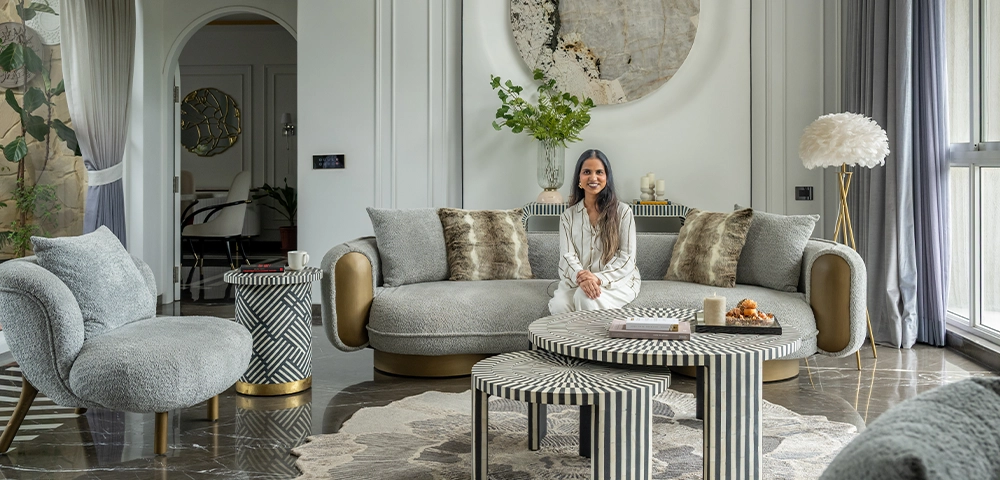
At Lodha Belmondo, Tinge by Rhea Truptesh creates a residence that draws from the language of Neoclassical design while embracing the simplicity and openness of contemporary living.
A great design is one that balances form and function with an innate understanding of the emotions that shape spaces. Exemplifying that perfectly is this very abode that transitioned effortlessly between the public and the private. This vision was manifested by Tinge by Rhea Truptesh. Nestled amid the lush contours of Pune’s Lodha Belmondo, this 3,800 sq. ft. home navigates the interplay between two contrasting aesthetics, developing a design vocabulary of its own. The result is a home that blends regal details with clean lines and a neutral palette.
Its grand proportions including an open, symmetrical layout and large windows allowed the designers to experiment. Introducing Neoclassical cues across the home, they tempered its inherent grandeur to suit contemporary sensibilities, ultimately coining the term ‘Neoclassical Minimalism’. This home thus revolves around three unwavering ideals: timelessness, functionality and understated elegance.
The clients envisioned a contemporary home centred around openness, fluidity and connection. Bringing this vision to life, the design unfolds around a striking double-height living space that flows into the kitchen, dining and bedrooms. At its heart, the living room acts as a connective spine, linking the social spaces on the lower level with the private quarters above. The adjoining kitchen and dining area maintain an airy flow, allowing light, movement and conversation to travel effortlessly throughout. Designed with flexibility in mind, the study can transform into a quiet retreat when needed, while remaining seamlessly integrated into the home's overarching sense of openness.
The smallest design decisions often leave the most lasting impression, lending a home its distinct identity. In the living area, a long monochrome marble wall panel diffuses light streaming in from the floor-to-ceiling windows, while subtle mouldings lend depth to the restrained palette.
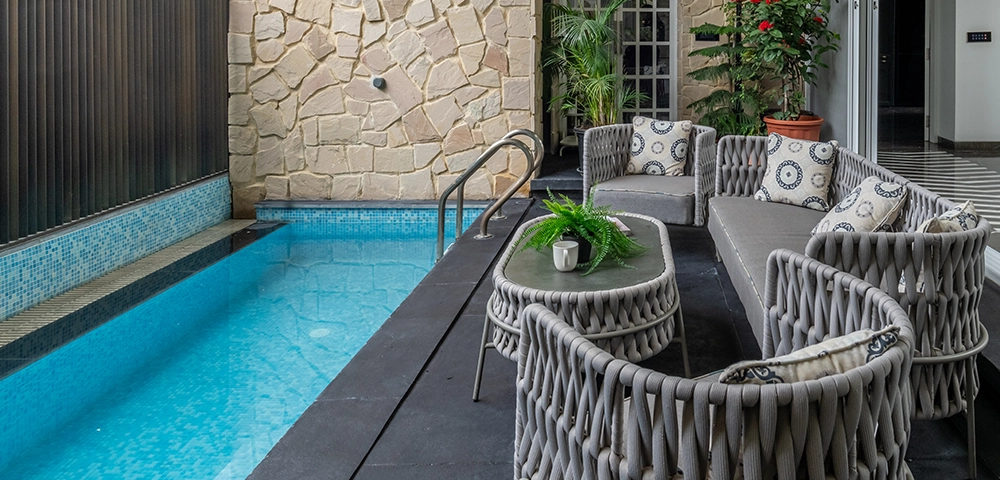
The space extends onto an alfresco retreat that draws inspiration from Neoclassical architecture through a contemporary lens. A sandstone-clad feature wall, circular motifs and a vintage street lamp create a setting that feels both timeless and inviting, offering a moment of quiet escape from the bustle of the city.
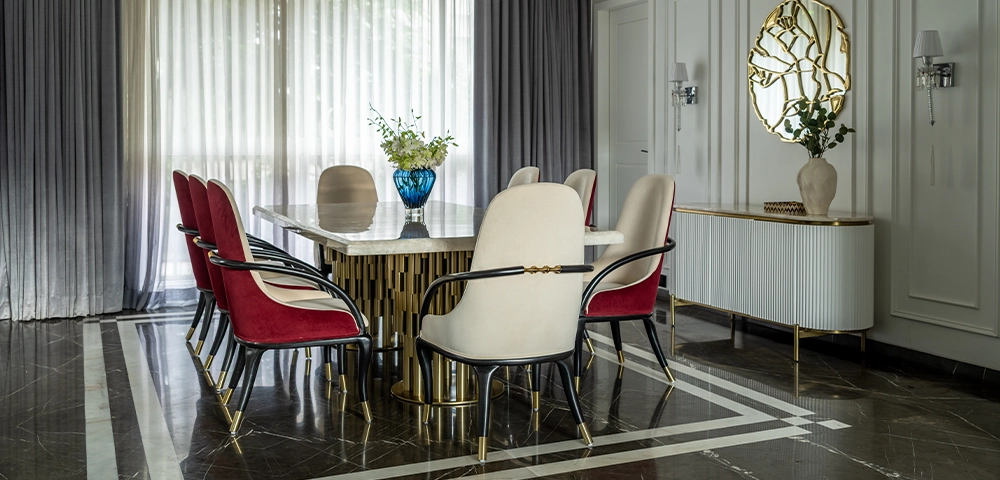
An element of the classical mise-en-scène, an arched doorway unfurls as a prelude to the dining area, its grandeur softened to suit a modern setting. With crystal chandeliers, a brass mirror, a marble dining table and other gilded accents, the room borrows references from the Classical Revival lineage, creating a sense of light and space.
A sculptural staircase leads to the upper level, where the home’s more intimate spaces unfold. While the living and dining areas are designed to bring people together, the bedrooms embrace a quieter, more personal rhythm.
Each of the three bedrooms is tailored to its occupant while remaining connected by a shared design language. The master bedroom is enveloped in a palette of muted pastels, layered with Neoclassical detailing and warm wooden flooring. The children’s rooms introduce playful accents of pink and blue, reflecting youthful personalities without disrupting the home’s cohesive aesthetic. Generous storage is thoughtfully integrated throughout, allowing everyday essentials and treasured keepsakes to co-exist.
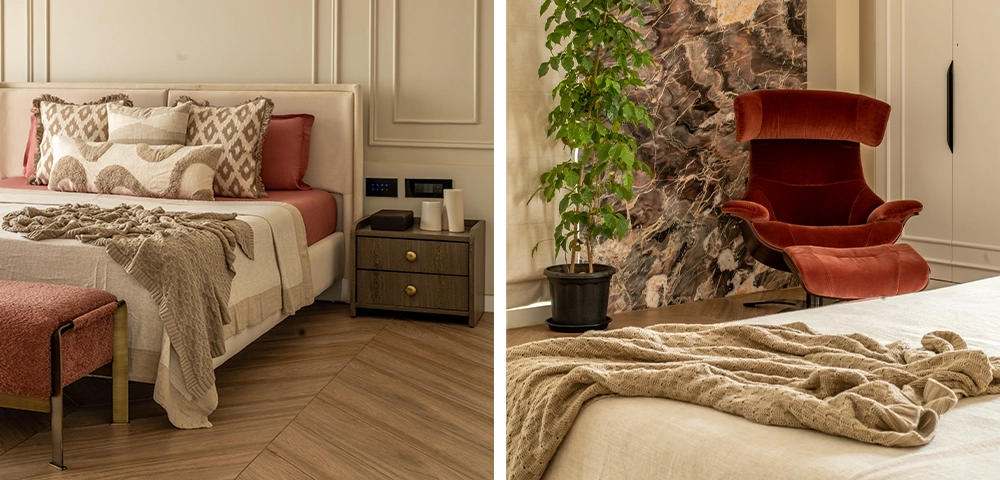
Soft neutrals like creamy whites, warm taupes and muted greys set the tone for this residence, creating a sense of calm and visual continuity. Against this restrained backdrop, accents of brass, gold and inky black introduce contrast, subtly drawing attention to architectural details and bespoke furnishings.
Marble, timber and brass are used with restraint, each bringing a distinct quality to the interiors. Marble lends clarity and refinement, timber introduces warmth, while brass appears sparingly to catch the light and accentuate key moments. Rather than competing for attention, these materials work in quiet concert, allowing the architecture to remain the focus.
In many homes, Neoclassical design is associated with grandeur and ornamentation. Here, it is approached with greater restraint. Decorative elements are carefully edited, proportions remain disciplined and every detail feels intentional. The result is a home that feels contemporary yet timeless, honouring the past while remaining firmly rooted in the present.
 Design & Architecture
 Design & Architecture
 Design & Architecture

 Enquire
 Call
Call
 chat
chat